

Near the end of Plato’s Republic, we find a remarkable passage about living one’s life. Socrates tells Glaucon a tale in which a certain Er, slain with many others in battle, returns from the death as a messenger from the other side. He tells about how the souls in the order assigned by lot each choose their next life. The choice is vast, yet entirely theirs. Having set the scene, Socrates tells Glaucon ‘that it is here… that a human being faces the greatest danger of all.’
Rather than provide a full essay discussing the context, content, and meaning of what follows, I’d invite you to read the passage for yourselves. The great humanist Erasmus of Rotterdam encouraged us to go ‘ad fontes’, ‘to the sources’; and so we do.
‘Now, it seems that it is here, Glaucon, that a human being faces the greatest danger of all. And because of this, each of us must neglect all other subjects and be most concerned to seek out and learn those that will enable him to distinguish the good life from the bad and always to make the best choice possible in every situation. He should think over all the things we have mentioned and how they jointly and severally determine what the virtuous life is like. That way he will know what the good and bad effects of beauty are when it is mixed with wealth, poverty, and a particular state of the soul. He will know the effects of high or low birth, private life or ruling office, physical strength or weakness, ease or difficulty in learning, and all the things that are either naturally part of the soul or are acquired, and he will know what they achieve when mixed with one another. And from all this he will be able, by considering the nature of the soul, to reason out which life is better and which worse and to choose accordingly, calling a life worse if it leads the soul to become more unjust, better if it leads the soul to become more just, and ignoring everything else: We have seen that this is the best way to choose, whether in life or death.
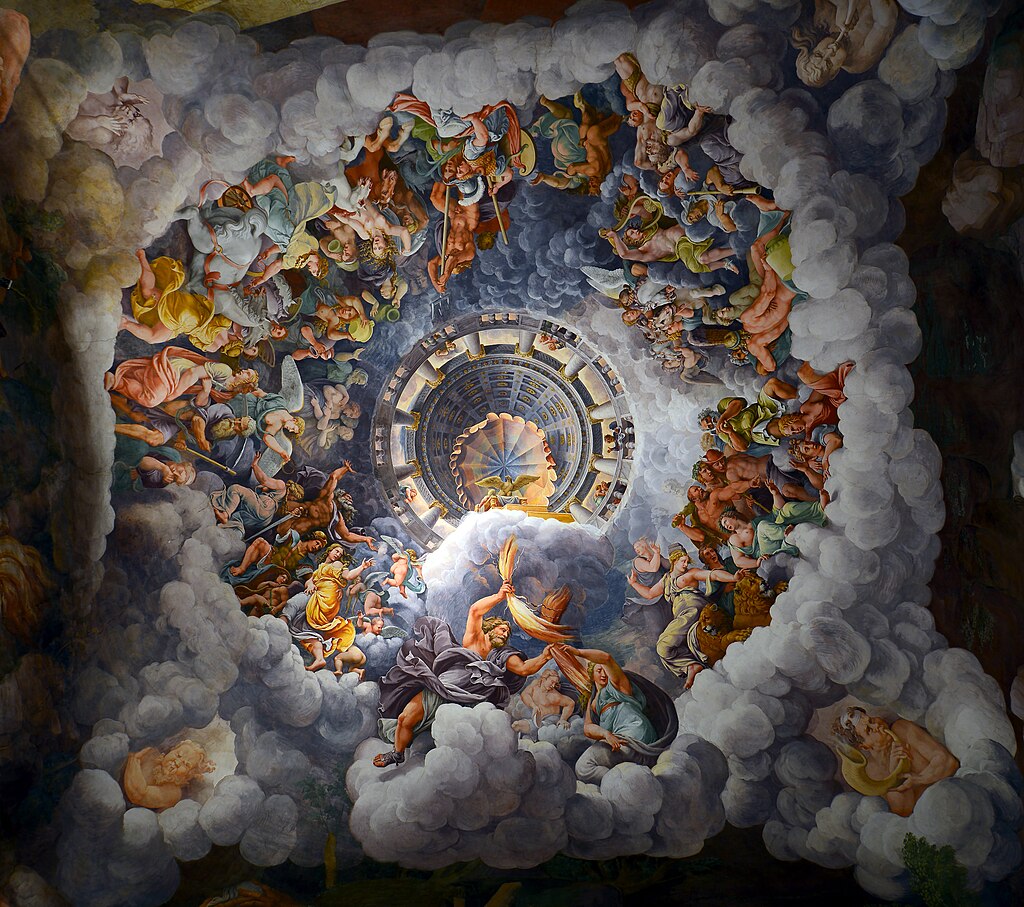
Giulio Romano – Soffitto della Sala dei Giganti di Palazzo Te, Mantova
Hence, we must go down to Hades holding with adamantine determination to the belief that this is so, lest we be dazzled there by wealth and other such evils, rush into a tyranny or some other similar course of action, do irreparable evils, and suffer even worse ones. And we must always know how to choose the mean in such lives and how to avoid either of the extremes, as far as possible, both in this life and in all those beyond it. This is the way that a human being becomes happiest.
Then our messenger from the other world reported that the Speaker spoke as follows: “There is a satisfactory life rather than a bad one available even for the one who comes last, provided that he chooses it rationally and lives it seriously. Therefore, let not the first be careless in his choice nor the last discouraged.” He said that when the Speaker had told them this, the one who came up first chose the greatest tyranny. In his folly and greed he chose it without adequate examination and didn’t notice that, among other evils, he was fated to eat his own children as a part of it. When he examined at leisure, the life he had chosen, however, he beat his breast and bemoaned his choice. And, ignoring the warning of the Speaker, he blamed chance, daemons, or guardian spirits, and everything else for these evils but himself. He was one of those who had come down from heaven, having lived his previous life under an orderly constitution, where he had participated in virtue through habit and without philosophy.
Broadly speaking, indeed, most of those who were caught out in this way were souls who had come down from heaven and who were untrained in suffering as a result. The majority of those who had come up from the earth, on the other hand, having suffered themselves and seen others suffer, were in no rush to make their choices. Because of this and because of the chance of the lottery, there was an interchange of goods and evils for most of the souls. However, if someone pursues philosophy in a sound manner when he comes to live here on earth and if the lottery doesn’t make him one of the last to choose, then, given what Er has reported about the next world, it looks as though not only will he be happy here, but his journey from here to there and back again won’t be along the rough underground path, but along the smooth heavenly one.’
Plato, Republic 10.618b-619e