Two or three years ago I had a friendly conversation in the common room of a college in a highly regarded English university. My interlocutor was a cheerful and ambitious student halfway through her master’s degree in public policy and climate change. Given the programme’s explicit concern with the needs of the present, I was not surprised to read a mixture of amusement and mild bafflement on the student’s face when she learned that my own studies had been in the Classics. I get that look often. Sometimes it is tinged with a benevolent pity. With so many more urgent things to be done in the world, why would one want to spend one’s days poring over dusty old books written in Greek and Latin? What could they have to do with us?
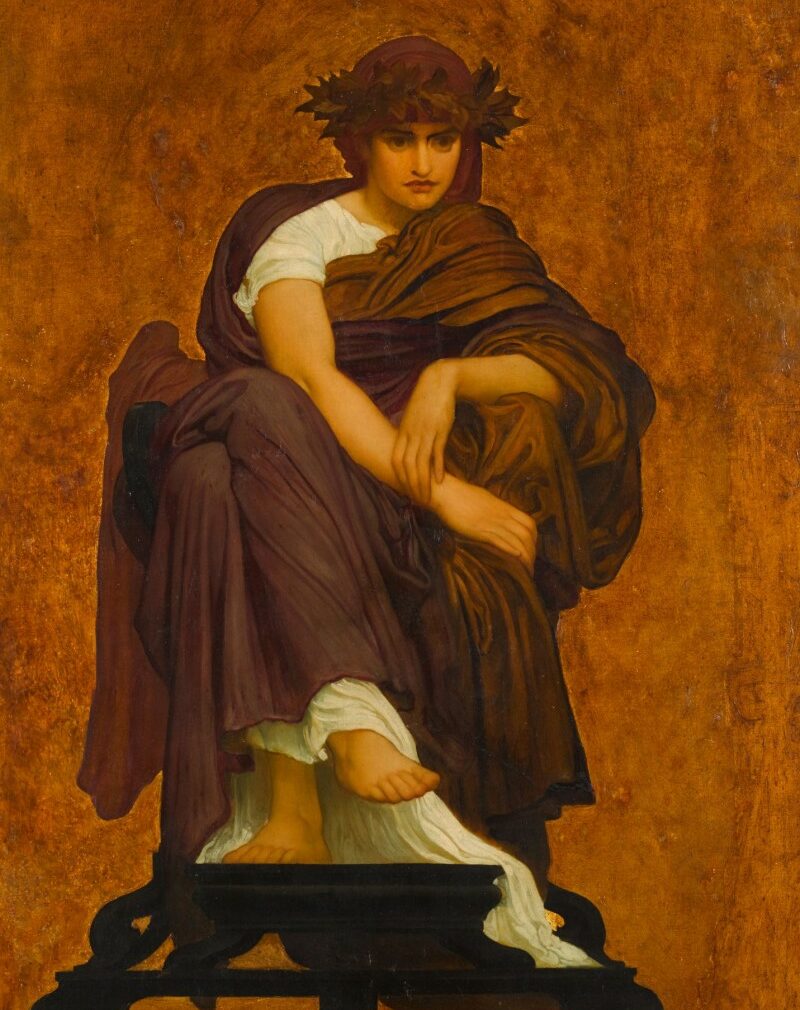
Mnemosyne, Mother of the Muses – Frederic, Lord Leighton, P.R.A.
Those questions are fair enough. In one form or another they have been agitating the West since the days of the Greeks themselves. Think of Plato and his quarrel with Homer and Hesiod, those purveyors of vicious tales about the gods. Think of Saint Jerome and his struggle to stop reading his pagan hero, Cicero. Or think of the various university spats over Aristotle, who was too atheistic for thirteenth-century Paris and too Christian for eighteenth-century Edinburgh.
History is thick with arguments—moralist, metaphysical, practical—over the contents of our cultural canon. Our age has its own vocal advocates for rejecting most of what has come before. It also has legions of the noncommittal and the indifferent.
It was to this latter camp that I initially assumed my collegiate interlocutor belonged. But as I began to explain what I enjoyed about my work—trying to understand how Greeks, Romans, and early Christians thought; who their heroes and villains were; what they hoped for in their cities and empires; what purposes they saw in their lives and in the cosmos—I saw the look of confusion deepen on her face.
“But—” she faltered. “But how can you answer those questions?”
I avoided a pedantic discourse on historical method and the problems of uncertainty, but I did note that, amongst other sources of evidence, we have to read the books that ancient authors left us.
Here the confusion turned to shock. “What do you mean?” she asked, wide-eyed. “What books?”
“Well, not just books, sure. But I mean in general: things people wrote. Plays, epic poems, speeches, letters, homilies, treatises. Those sorts of things.”
“Really? They wrote things?”
Now it was my jaw’s turn to drop. In the student’s own telling, she had never learned that there was a large body of Greek and Latin literature that had survived from Antiquity, not to mention that it contained profound reflections on what it means to be human, that it had been read continuously in different parts of the world from generation to generation, that it had shaped the civilisation she was ostensibly hoping to save, that it could be read even now, and that it remained a source of inspiration and a worthy object of admiration and study.
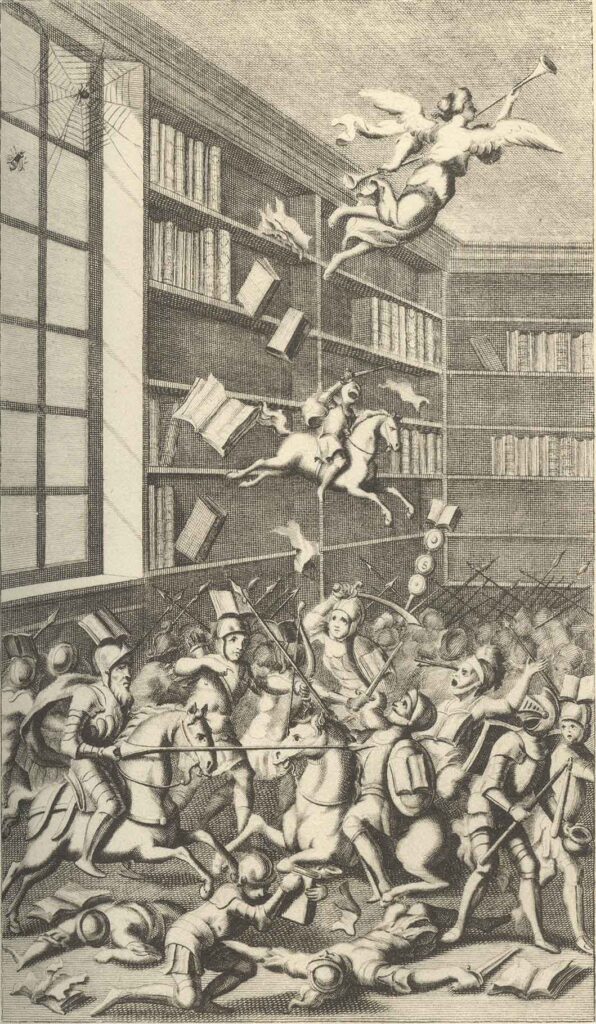
Woodcut from the “The Battle of the Books” – Jonathan Swift
I left that conversation struggling with a deep sense of despair. In the heart of what was ostensibly one of the world’s best universities, a motivated student in her early twenties, one who hoped to go out and change the world, had absolutely no idea what that world was. I would like to think that hers was an extreme case. So it may be. But I am afraid that it is not an isolated one. Earlier I mentioned the legions of the indifferent—those who know, for instance, that Greeks wrote things, even if they do not know enough to care or have imagination enough to be curious. Alongside those legions, it turns out that there are the legions of the utterly oblivious, those adults who have been so systematically undereducated that their knowledge of very basic facts about their own civilisation cannot even approach the standards expected of a ten-year-old in 1920 or even 1990. This fundamental knowledge, even in outline, serves as a set of compass bearings by which we orient ourselves as we strike out over the terrain of our own times. Without it, we are lost. A total lack of orientation is pitiable in a master’s student; it becomes dangerous in a lobbyist, a bureaucrat, a businessman, and a politician.
Tragically, the great centres of learning and the schools that feed them have long been nurturing an implicit cult of precisely this oblivion. Curricular choices, teaching methods, and simple practices of extracurricular institutional life have all played their part. The rot often runs deep.
We must of course hope for reform. We ought also to encourage those in the ancient institutions to wage their fights nobly and well. But one of the best ways to do so is by living out another sort of learning, one that is at once older and newer than most of what we see today. Where the elite universities have forgotten, where they have neglected to pass on the knowledge and the habits that keep the fonts of culture flowing, rogue start-ups have the opportunity to remember, to make that memory present, and to teach so as to bring it to life for posterity.
Students of such institutions quickly encounter that first Socratic struggle to shed the ‘ignorance of ignorance’: they learn that there is much that they do not know. That humbling recognition is what allows them to learn. By the time they graduate, they really do know something about where we have come from. But they also know that shared story and its characters as it were from within. As such, they go out into the world to face the very real needs of the present with energy and enthusiasm. More importantly, they look forward to the future with the perspective, clarity of thought, and courage that are possible only when anchored in truth.
Dr Brian Lapsa
Director of UK and European Operations
Professor of Classical Humanities