Today, we face a paradox in education. While modern society boasts high levels of schooling and access to knowledge, trust in our education system is at an all-time low. Students earn degrees, yet few seek wisdom. Schools impart skills, yet fail to cultivate the soul. What has gone wrong? And how can we reclaim education’s true purpose?
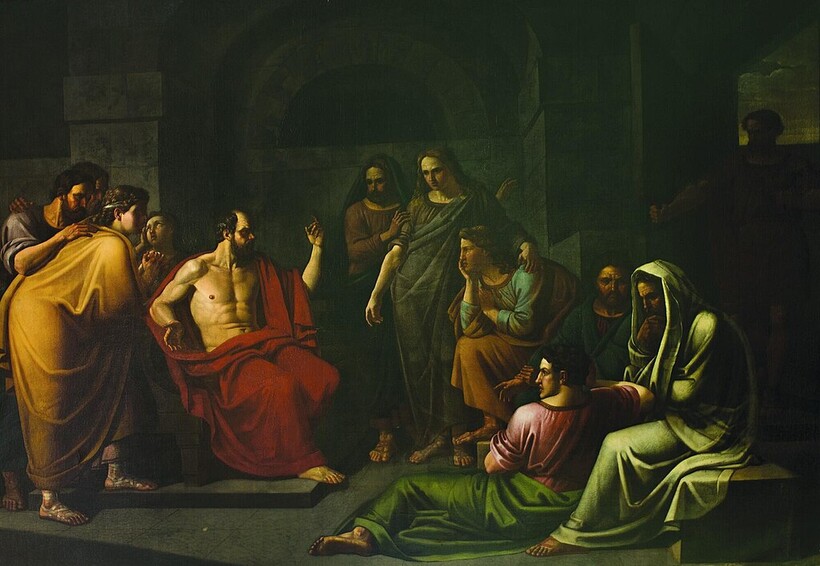
Aleksandr Notbek, Socrates With His Students, 1831, Irkutsk Regional Art Museum
Historically, education was founded on the pursuit of truth, wisdom, and moral character. The Academy of Plato, Aristotle’s Lyceum, and the great Medieval universities were institutions that sought knowledge grounded in timeless wisdom, shaping individuals for life’s challenges. Yet today, education has lost its mission. Instead of imparting wisdom, it prioritizes career advancement, wealth, and social status, often relegating intellectual formation and moral growth to the background.
Beyond this loss of focus, academia has become self-referential, serving itself rather than truth. The pursuit of knowledge has been supplanted by a culture of intellectual conformity, where academics devise ideologies that are endlessly repeated in classrooms, severing education from the realities of the world. This is particularly evident in the humanities, which often function as ideological echo chambers rather than fields of rigorous inquiry. The result? Students graduate well-trained but ill-equipped to think deeply or critically.
More troubling still, education has been hijacked by ideologues who manipulate knowledge for power. Instead of fostering open inquiry, many educators promote rigid, one-sided narratives that discourage true intellectual engagement. The modern university, once a forum for vigorous debate, now often silences dissent.
Can this decline be reversed?
If education is to reclaim its transformative power, it must once again be seen as soul care—a means of fostering wisdom, moral integrity, and intellectual curiosity. This requires four key changes:
True authority in teaching is not about power but about transmitting enduring truths. A good educator draws upon knowledge that has stood the test of time. Just as medical training relies on centuries of accumulated understanding rather than passing fads, so must the humanities remain rooted in foundational texts and ideas. A society that forgets its intellectual inheritance, as C.S. Lewis put it, “is cutting itself off from the wisdom of the past and thus dooming itself to repeating old errors.”
Modern education often emphasizes ideological activism over intellectual and moral foundations. Instead of obsessing over identity politics and fashionable theories, students must engage with the great ideas of history, philosophy, literature, and theology. To ignore these is to sever ourselves from the very roots of civilization. As Chesterton observed, “Education is simply the soul of a society as it passes from one generation to another.”
True education does not merely transfer information—it awakens curiosity. The best learning occurs when students are led to discover knowledge for themselves, encountering truth through deep engagement and rigorous inquiry rather than passive acceptance. Socrates understood this well, using the *maieutic* method to draw knowledge out of his students rather than impose it upon them.
Education is not merely about accumulating knowledge but about learning how to live well. A true education forms not only the intellect but the whole person. It teaches individuals to confront difficult questions with honesty, humility, and courage.
Education is not an isolated intellectual exercise—it is a journey toward truth. In Plato’s Allegory of the Cave, the prisoner who escapes into the light has a duty to return and free others. But this return is costly. He risks his life doing so. It requires courage to challenge ignorance, patience to seek wisdom, and humility to recognize the limits of human knowledge.
Ultimately, education must lead beyond itself. True humanism recognizes that knowledge alone is not enough—it must be ordered toward something higher. Without a connection to the transcendent, education risks becoming a closed system, a prison of our own making. The way out of this prison is the same path that has always led humanity to wisdom: the search for ultimate truth, embodied in the one who declared, “I am the way, the truth, and the life.”
Dr Jan Bentz